| |
End-to-end
Economics
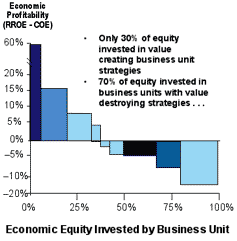
By “end-to-end economics” we mean the true and complete understanding
of the sources and magnitude of value creation across the organisation
including the underlying drivers of value by product, customer, channel
and operational activity
 |
 |
 |
|
Economic
profit is about understanding whether the bottom line that any given
product, customer, channel or activity delivers to shareholders is
sufficient to compensate for the risk of the investment.
 |
|
i.e.,
Earnings less a charge for equity capital invested |
|
| |
|
|
|
| |
|
|
Traditional financial
and management accounting often distorts the underlying picture of
economics, problem areas include:
|
|
Transfer
pricing policies |
|
|
Accounting
and depreciation policies |
|
|
Inflation
adjustment |
|
|
Lack of
/ or non-economic capital allocation |
|
|
Large central overheads |
|
| |
|
|
|
| |
|
|
Understanding
the end-to-end economics leads to an improved picture of the value
drivers for the business – with often surprising insights –
and, together with a strategic fact-base of markets and competitors,
is the foundation of superior strategies and superior execution |
close window
|
|